

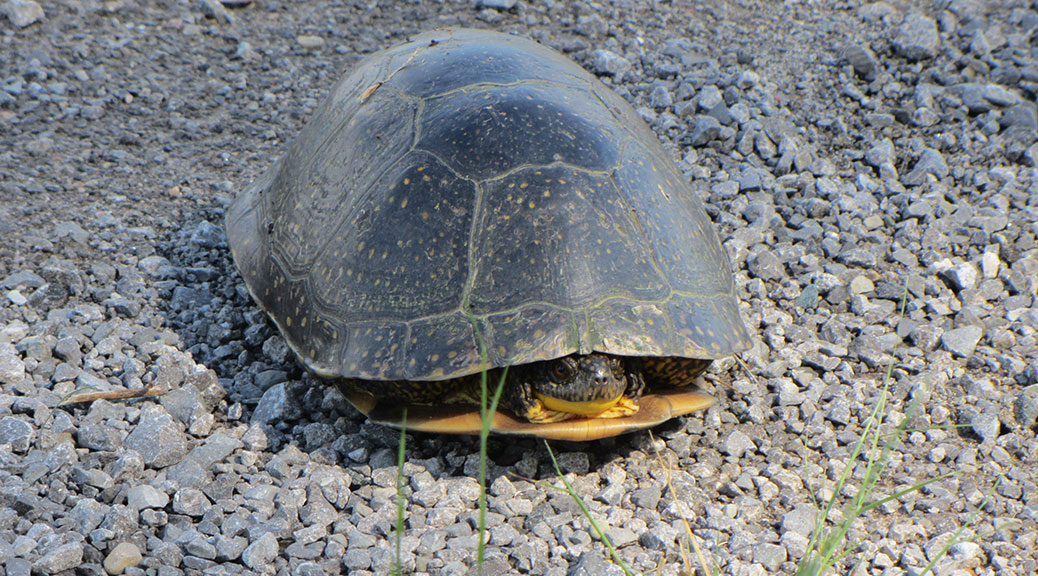
(File photo: Blanding’s Turtle along Hazeldean Road. Photo by Ken McRae.)
Minto is proposing several measures to protect Blanding’s Turtles at the new Potter’s Key development on Hazeldean Road. They’ve applied to Ontario’s Ministry of Natural Resources and Forestry (MNRF) for permission to proceed with the development, which could impact the animals, classified as a Species at Risk in Ontario (SARO).
Construction could affect up to 21.3 hectares of the species’ habitat. This type of MNRF permit is not uncommon for developments in our area, and is required if there’s a potential that any endangered or threatened species’ habitat will be disturbed.
Some of the steps Minto says they’ll take to mitigate the impact include:
• Fencing and marking any habitat to be retained during and after construction to reduce damage to habitat as well as harming individual turtles.
• Keeping travel corridors used by the species intact to avoid isolation.
• Species education and awareness training for construction staff.
• Enhancing turtle habitat by undertaking channel restoration of Feedmill Creek to create a natural protected vegetated riparian corridor.
• Installation of barrier fencing along the restored riparian corridor to reduce turtle mortality.
• Species information packages for new residents.
You can read more about the permit application here. Members of the public are invited to submit their written comments by August 8, 2016 by email to erin.seabert@ontario.ca and quote ER number 012-8004 in the subject line.
ABOUT BLANDING’S TURTLES
The Blanding’s Turtle is a medium-sized turtle easily identified by its bright yellow throat and chin. Unlike most Ontario turtles that have wide, flatter shells, the Blanding’s Turtle has a domed shell that resembles an army helmet.
Blanding’s Turtles live in shallow water, usually in large wetlands and shallow lakes with lots of water plants. It is not unusual, though, to find them hundreds of metres from the nearest water body, especially while they are searching for a mate or traveling to a nesting site.
The most significant threats to the Blanding’s Turtle are loss or fragmenting of habitat, motor vehicles, and raccoons and foxes that prey on eggs. Illegal collection for the pet trade is also a serious threat.
Blanding’s Turtles are slow breeders – they don’t start to lay eggs until they are in their teens or twenties – so adult deaths of breeding age adults can have major impacts on the species. This long-lived species can survive in the wild for more than 75 years.
Source: Ontario.ca