

(EDITOR’S NOTE: Poole Creek may be Stittsville’s most important natural feature. It meanders from west to north east, crossing through neighbourhoods old and new, playing a crucial role in our community’s ecology. In the second part of this series, ecologist Nick Stow follows the creek as it heads east of Stittsville Main Street, entering a stretch that remains largely unsurveyed and uninventoried. All photos by Nick Stow.)
JUST EAST OF MAIN STREET, POOLE CREEK TURNS NORTH AND DISAPPEARS into a large remnant of Stittsville’s once extensive wetlands. Almost inaccessible, the wetland remains largely unsurveyed and uninventoried. However, I suspect that an bioinventory would likely reveal several species at risk, especially Blanding’s turtle, which is known from the Goulbourn Wetland Complex and several isolated observations elsewhere in the village.
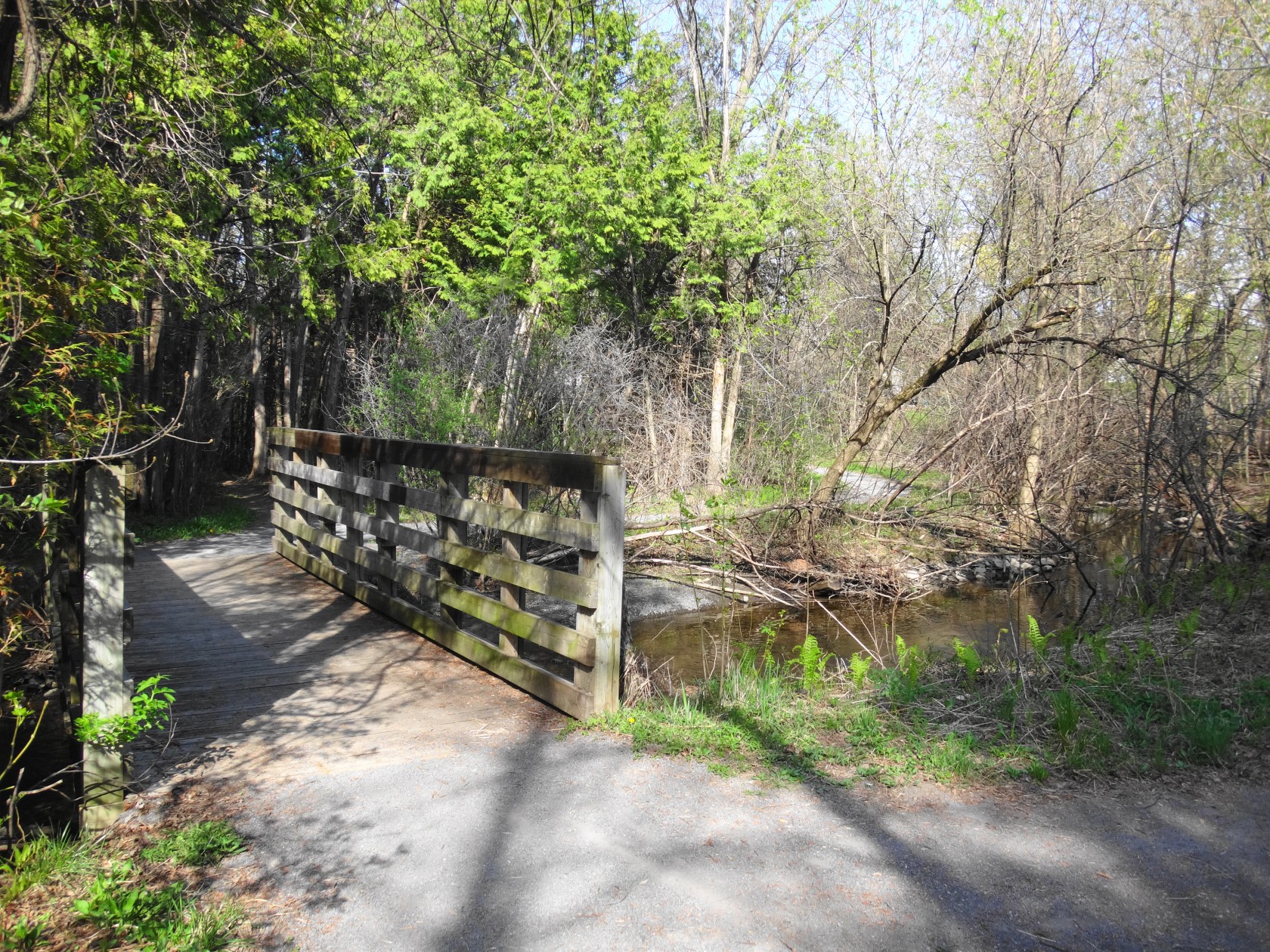
From the wetland, the Creek runs through the Amberwood Village Golf and Country Club, finally emerging back into the public realm at Springbrook Drive. You can bypass the wetland and golfcourse by following the trail out on to Beechfern Drive (crossing a pretty little bridge on the way), and then taking every left turn until you arrive at Springbrook. Along the way, you will follow a short, pretty trail between Hesse Crescent and Pine Bluff Trail, crossing a bridge over a small tributary. The bridge provides a good place to pause and watch dragonflies, or listen to chickadees and common yellowthroats singing in the shrubs.

The trail picks up again on the north side of Poole Creek, where it crosses under Springbrook Drive. This is a good place to see the impact of emerald ash borer on Ottawa’s urban canopy. Where the trail once entered a shady grove, it now passes through a bright, open woodland, dotted with the stumps of ash trees. Killed by the little, invasive green beetle, the dead trees posed a safety hazard to the children and other residents using the trail. Although shocking at first glance, the clearing will soon be hidden by the growth of new shrubs and trees taking advantage of the abundance of light.

The stretch of Poole Creek between Springbrook Drive and Sweetnam Drive may be its prettiest section. The creek burbles happily through the forest, then crosses under a footbridge into an open wetland. On the south side of the creek, where the trail runs, some adjacent residents have taken it upon themselves to clear a small grassy area down to the creek bank. Normally, the City frowns on such incursions into public natural areas. In this case, though, the lawn provides views up and down the creek, allowing greater appreciation of the marshy floodplain.
In past years, beavers dammed the lower end of the reach, creating a pretty pond, which the City managed through use of a “beaver deceiver” to prevent flooding of the trail. Although they have now abandoned the site, the beavers will no doubt return in the future. In the meantime, the area still provides a wonderful place to observe birds, including the occasional great blue heron hunting frogs along the creek, or a Cooper’s hawk hunting unwary snakes. A quiet, careful observer might even find painted turtles sunning themselves on the banks.

***
NEXT IN THIS SERIES: When Poole Creek crosses Hazeldean Road, it passes through one of Stittsville’s newest neighbourhoods, Fairwinds. It’s in the midst of a transformation from farmland to forest. Read it here…
(This story originally appeared on Nick Stow’s Naturally Ottawa blog and is republished here with permission. Stow is an ecologist and environmental planner and works for the City of Ottawa.)