

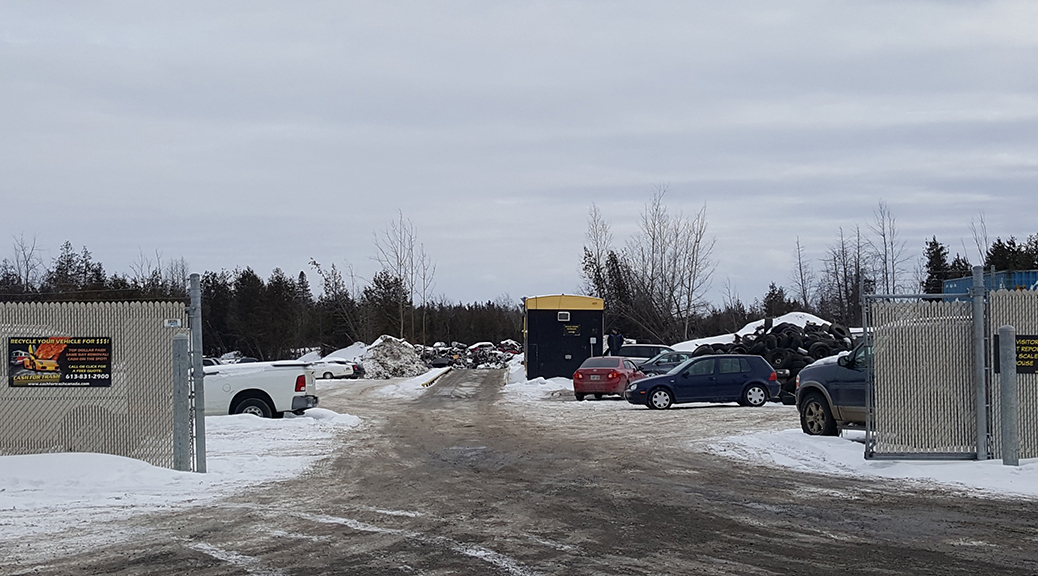
A four-year-old zoning scrap between the City of Ottawa and a Goulbourn scrapyard could wind up back in court, as the area’s city councillor criticizes what he says is “blatant” noncompliance by yard management.
The controversy for Cash for Trash at 7628 Flewellyn Road surrounds how it uses its 50-acre property. The facility opened in 2012, much to the displeasure of residents who live nearby. The business salvages old vehicles, stripping them for useful parts and storing old wrecked vehicles on site. A large fire broke out in the scrapyard in July 2015.
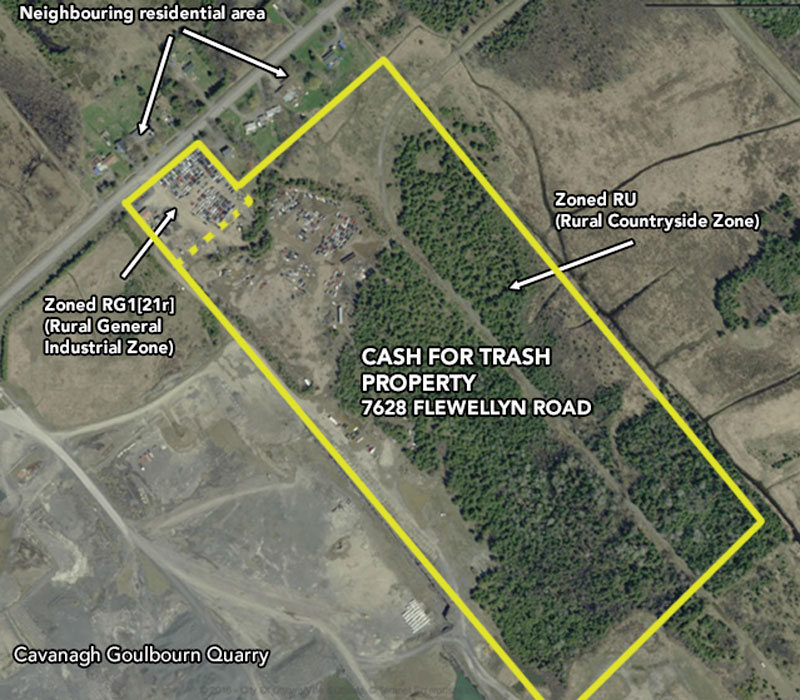
According to the City, the junkyard is only allowed to use a two-acre parcel adjacent to Flewellyn Road, which is zoned as “rural general industrial.” The rest is “rural countryside,” which does not allow for industrial activity such as a scrapyard.
Cash for Trash believes they have a right to not conform to the zoning, based on historical precedent on how the land was used in the past. A large portion of the area zoned as “rural countryside” is being used to store old vehicles.
“We have been denied based on a by-law, apparently that the city is relying on, from the 60s,” said Victoria Freeborne, Cash for Trash’s office manager, in an interview. “But that by-law is actually incomplete… it [was] repealed in 1964, so we believe that we do have the right to use the back [of the lot.]”
Rideau-Goulbourn Councillor Scott Moffatt said part of their operations, clearly shown in a 2016 aerial photo, is operating in violation of the land use zoning.

At a meeting with neighbouring residents back in September, Moffatt presented a slideshow with aerial photos taken between 1976 and 2016, which showed a progressive, year-over-year increase of cars being stored in the back part of the land, along with deforestation in some parts.
In 1991, when there was a previous owner on the land, a few cars were stored on the “rural countryside” portion. Today, aerial photos show hundreds of cars in the same area.
“The 2016 picture shows a blatant disregard [for zoning],” Moffatt said.
***

Up until recently, old cars were piled high at the front of the lot, towering over a fence at the front of the property along Flewellyn. In 2015 Charbel Bouroufail, the owner of Cash for Trash, told StittsvilleCentral.ca moving them to the back of the property would distance them from homes and cut down on noise, allaying some of the neighbours’ complaints.
Freeborne said they will continue fighting to move their operations further back to the lot and that they may take the City to court over the issue.
Moffatt said he feels it’s too little too late.
“There was a time for that,” he said. “I think there’s more than that… we’re now four years into this.”
He said it’s probably best for the community if Cash for Trash wasn’t operating there. He isn’t against scrapyards and said he has several in his ward, but this is the only one that operates in a residential area.
The city is currently building a case to lay a charge against Cash for Trash, based on the fact that they haven’t removed vehicles from the back portion of the property. If the city obtains a conviction, Moffatt says that could be used as grounds to revoke their business license.
He said he wants to work with the owners, but the city’s patience is wearing thin.
“If they don’t comply, we don’t have a choice,” he said.
(Here are the slides from the public meeting that Councillor Moffatt hosted in September 2016.)