

EDITOR’S NOTE: This ongoing series on Boyd House, an old stone farmhouse on Huntmar Drive, originally appeared a year ago on OttawaStart.com. We’re republishing and updating the original research here on StittsvilleCentral.ca.
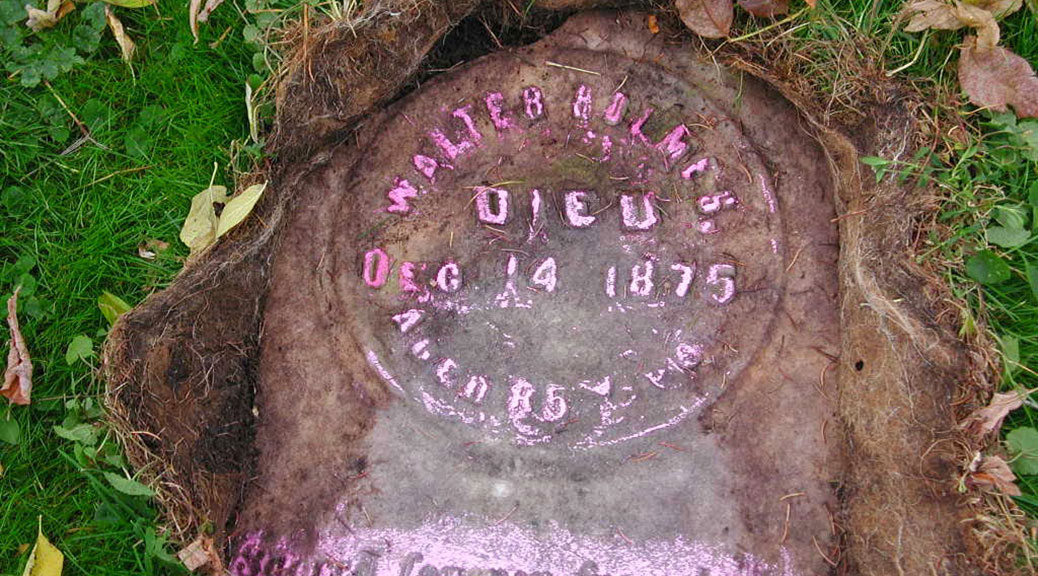
In the 1980’s, previous owners of Boyd House at 173 Huntmar Drive found two old headstones under an old summer kitchen attached to the home. The names on the stones were “William Alexander” and “Walter Holmes”. Who were they?
I was stumped when I started researching this home back in 2013-2014. Nobody named Alexander or Holmes is ever listed as a property owner there, and I wasn’t able to find any direct family links to the Boyd’s. Every once in a while I’ll run a search on Google or Ancestry.ca to see what comes up. Here’s what I’ve uncovered so far.

William Alexander’s grave stone is obscured here but the visible part says he died on August 10, 1868. That appears to match with a genealogical record for a William Alexander born in 1804 in Tyrone County, Ireland.
There’s a second grave marker in the Carp Presbyterian Cemetery for William Alexander:

William was married to Margaret (Davidson) Alexander, and father to a large brood that included Andrew, Ann, Rebecca, Margaret, Elizabeth William, James, Hugh, Sam, Isabel and Francis.
Here’s a possible link:
- William’s daughter Margaret married Sam Bradley.
- Sam Bradley was the brother of Jane (Bradley) Boyd, the original owner of the stone house at 173 Huntmar.
- In other words: William Alexander’s son-in-law’s wife was Jane Boyd, who lived at 173 Huntmar.
There’s a problem with that link: Jane and her husband James Boyd probably didn’t live on the property until they were married in 1875. (James Boyd bought the property in 1872.) So was Alexander (who died in 1868) buried on the land before the Boyds arrived? Or did they bring the headstone with them for some reason?
It’s also possible that Alexander was linked to the previous landowners, the Burroughs. In fact, descendents of the Burroughs contacted me to say they believe Alexander was a father-in-law to someone in their family.
It’s also quite possible that William Alexander is connected to both the Boyds and the Burroughs. There is a lot of crossover between the branches of the family trees in Huntley Township from that era.

But what about this Walter Holmes fellow? What was his connection to the Burroughs/Boyd families? Holmes also has a headstone at Carp (Huntley) Presbyterian Cemetary. Same text, same date of death: died December 14, 1875 aged 85 years. A line of text engraved at the bottom: “Erected by Ellen Holmes”.

So far I have been unable to find a family link between Walter Holmes and either the Burroughs or the Boyd families. Various research suggests that:
- Holmes was born in 1789 or 1790 in Tyrone County, Ireland. (That’s roughly 14 years before William Alexander was born, in the same Irish county.)
- A Walter Holmes owned land at Concession 1, Lot 12f in Huntley, a few kilometers north of 173 Huntmar. In the 1879 Belden Atlas, four years after Walter’s death, the property is shown as belonging to his brother Robert Holmes.
- He appears in the census in 1851, 1861, 1871. His occupation is “Farmer”
- His parents were James and Jane Holmes (coincidentally, the same first names as James and James Boyd, the original owners of the stone house on Huntmar).
- Ellen Holmes is listed as his wife in the 1861 and 1871 census. His wife is listed as “Eliza” in the 1851 census. Both appear to be the same woman, about 20 years younger than Walter.
There were lots of Holmes in the area. In fact, the intersection of Huntmar and Old Carp Road used to be known as Holmes Corners.
One link to the Boyds: in the 1851 census, a 6-year-old James Boyd appears on the same page. So Walter was likely a neighbour with James Boyd’s family who lived nearby in Huntley.


There’s a gravestone in the Carp Presbyterian cemetery for “William MacConahey, Father of Ellen Holmes.” He died January 25, 1870 at age 75, making him about five years younger than Walter.


Ellen herself is buried at the cemetery as well with Walter. It reads: “His wife Ellen Died in the Township of Huntly Jan. 4, 1882 Ae. 83, Yrs.”
***
One possible explanation for both gravestones is “recycling”. Life in the 19th century was tough, especially after the Great Fire of 1870 that decimated the area. A cemetery stone was just a piece of rock and if it could be put to good use somewhere, it would be. For example, tilling time. Here’s how one source explained it to me: “At tilling time, farmer used to like to load their tillers with heavy stones to make sure the soil would be tilled deep enough. Old cemetery stones sometimes got a new life as tilling weights. In the past, there was not the respect we have today for cemetery stones.”
***
Have the true stories of William Alexander or Walter Holmes been taken to the grave by their family, friends and neighbours? Or are there still historical records that exist that can help solve the mystery? Any readers with more information can add a comment below or email feedback@stittsvillecentral.ca.
Big thanks to Christopher Ryan, Gordon Dewis and Ian White for their assistance in researching this post. Headstone photos are via CanadainHeadstones.com.
PREVIOUSLY: Family memories of Christmas on the farm, and more (Part 5)
Do you know anything about this house or the Boyd family who lived there? Send us a note at feedback@stittsvillecentral.ca.