

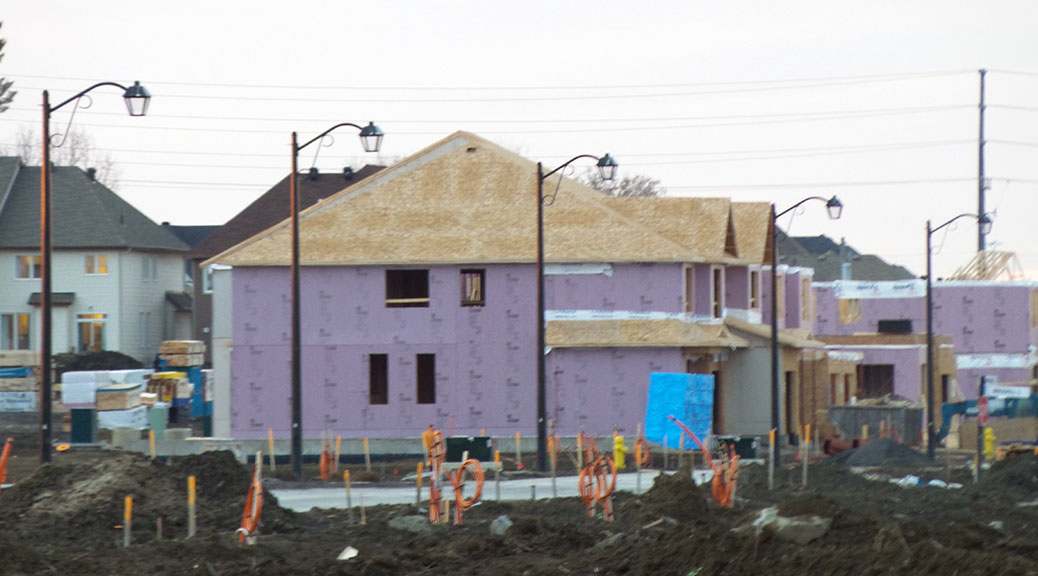
(Photo: Poole Creek Village under construction.)
On November 7, the Greater Ottawa Home Builders Association (GOHBA) took out a quarter page ad in the first section of the Ottawa Citizen entitled “Empowering Millennials to Succeed”. It was a blatant pitch to the newly-elected federal government to seek reductions in municipal development charges on newly constructed homes in order (nominally) to support young millennials in purchasing these homes.
You will recall that development charges are to pay for the municipal infrastructure costs associated with new development (roads, water, sewers, etc.) so that existing taxpayers do not end up paying more in property taxes for the costs of new development (and consequently subsidizing the new development).
It should come as no surprise that there is a demand curve for new homes. Higher prices (including the land transfer tax, development charges, construction costs, and profit) reduces the demand for these new homes. One would think that higher prices would create pressure for more efficient land development, but (surprise!) it is profit which directs developers in the housing market.
Nothing wrong with that in principle, but when the GOHBA starts pushing public policy-makers to change public policy to their advantage, we should pay attention. There is a reason why we have development charges (so existing taxpayers do not subsidize new development) but clearly one can see why developers would like to reduce these charges: lower charges = lower prices = more sales = more profits.
***
The GOHBA has also targeted the Land Transfer Tax (LTT) issue. Currently only the City of Toronto has access to the LTT (a charge for when land changes hands, usually on the road to higher zoning and development). The Ontario Government is reviewing the Ontario Municipal Act to provide the opportunity for other municipalities to charge the LTT. This is seen as helping municipalities gain some new revenue to meet their infrastructure and other responsibilities.
Obviously the LTT would add to the cost of a new home (the GOHBA says about $5,300 to the average price of a new home). Again, one would think that this would lead to more efficient land use, but instead the GOHBA is suggesting that the new federal government disburse its promised infrastructure money on a quid-pro-quo basis to municipalities for dropping development charges, in order to “help” millennials buy homes.
How nice for the millennials, and for the developers who make up the GOHBA, but not so nice for taxpayers who have already paid through their taxes for the infrastructure that supports their homes. The GOHBA proposal would add to everyone’s property taxes and subsidize not only the millennials but the profits that would accrue to the GOHBA and their friends.
I bring this to your attention as a topic to pay attention to. In this instance the interests of the GOHBA and ordinary property taxpayers are not the same. You may want to let your newly-elected MP know this.
(Alex Cullen is former MPP, city and regional councillor and school board trustee.)
***
RECOMMENDED READING: “Public trust and the City’s development charge agreement”. Councillor Tobi Nussbaum wrote in October about the city’s decision to roll back development charges, and freeze any changes until 2019. A brief excerpt:
“The city is obligated to demonstrate the highest level of openness and transparency, particularly when dealing with the development industry. A settlement agreement, negotiated and debated behind closed doors, that alters a publicly-consulted set of rules and provides veto power to developers over City decisions, does not meet that test. The result of that failure is a loss of public trust.”