

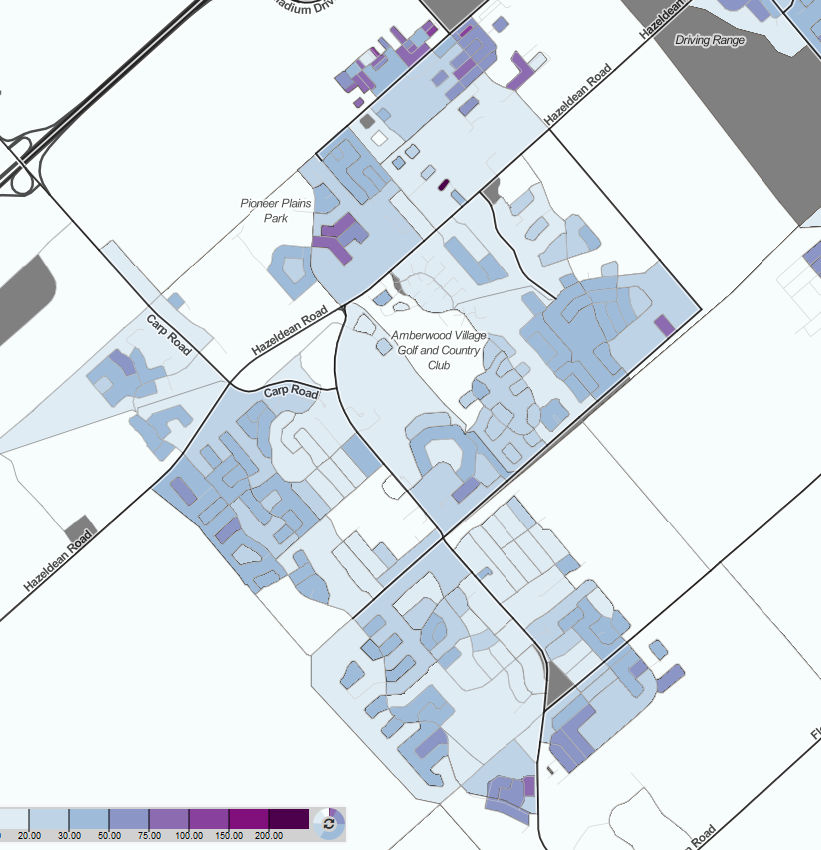
The image above visualizes the density levels around Stittsville. The darker the colour, the more people per hectare reside there. Here’s an interactive version.
What would the community look like with more density? Here are three ways we could benefit.
1. Better transit
One of the biggest concerns when it comes to low-density development is in the added cost of delivering municipal services — for example, it’s cheaper and easier to run water lines into a 30-unit apartment building than a 30-unit single-detached subdivision.
This logic also applies to transportation infrastructure. Urban sprawl, caused by low density, requires more roads — increasing construction and maintenance costs.
Transit is affected too. OC Transpo tries its best to serve Stittsville’s winding boulevards, but they can never do that effectively. High-density residences put a larger number of riders into a smaller geographic area, making it easier for them to get to bus stops and easier for the city to provide buses.
The good news is the city encourages high-density development along transit corridors — so we can expect to see that around Palladium when the Confederation Line eventually makes its way out here (in the 2030s.)
2. Great for business
High-density development would enable a stronger local business community in Stittsville.
Imagine more residential spaces along Stittsville Main Street. Each building would put a clump of potential customers within walking distance of any number of local businesses. No business wouldn’t want that.
This is also why it’s important to ensure there is a good mix of business in areas where we want to see high-density development — but that’s a planning issue for another day.
3. More people can live here affordably
By the laws of economics, more residential units — of any kind — means they cost less. High-density development would maximize the supply of available units, allowing more people to either join our community, or prevent existing residents from being priced out of Stittsville.
However, this requires attention to ensure there is a good mix of units being built. As previously covered by StittsvilleCentral.ca, the majority of existing apartment stock are luxury units. While there is nothing wrong with building more of that, we must also ensure that there is ample opportunity for developers to provide affordable housing as well — for rental and for ownership (do we want to turn into just another high-end Condoville?)