

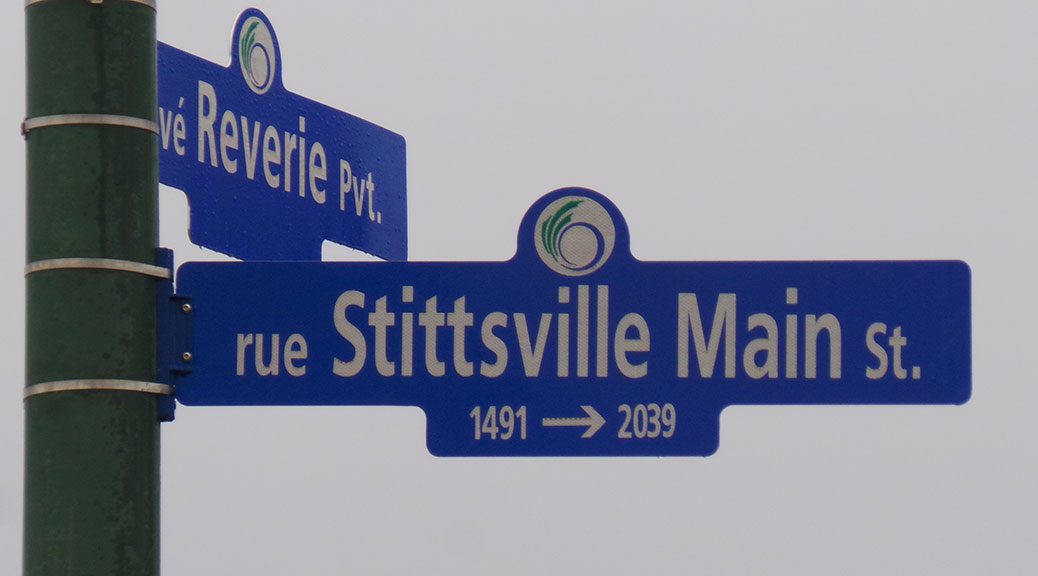
The Ottawa Citizen published an interesting opinion piece from Charles Lanktree today about the Stittsville Main Street Community Design Plan (CDP).
He argues that the CDP recently approved by the city’s planning committee is not dense enough, and should have allowed for higher buildings.
In the article, he’s described as a “Registered Professional Planner and resident of Ottawa”, but it’s worth noting that he was also the lead planner for the City of Ottawa on the CDP file until last fall, when Mark Young took over.
Here’s an excerpt:
When we look at the demographics of Stittsville, we see that it is projected to grow from some 27,000 souls in 2011 to well over 70,000 by 2031. As with many of the communities outside the greenbelt, Stittsville is outpacing the rate of growth of the city as a whole.
So one may wonder why its CDP can accommodate only 500 new dwellings. This seems rather low for an area that is supposed to provide for intensification with a more compact, mixed use and walkable environment. But the predominant form of development in Stittsville, as with many other suburban communities in Ottawa, remains the broad expanses of single detached dwellings, extending beyond walkable ranges for most to do local errands. This inefficient development pattern has come to be known as sprawl.
This is where the physical character of Stittsville Main Street provides an opportunity. The former rural village affords very deep lots along the street, many of which are 90 metres deep. This distinguishes them from inner-city Mainstreets with 30 metre-deep lots where taller buildings and more abrupt transitions are occurring. This greater lot depth provides for a more gentle transition of height and use to the surrounding neighbourhoods where three storey buildings are currently permitted. Also, the width of Stittsville Main Street varies from a substandard 15 metres for a short stretch in the old village core to a generous 30 metres to the north and south. In these 30-metre sections, a 20-metre-high, six-storey building wouldn’t seem so tall — and certainly not a “canyon” by any stretch.
Unfortunately, these opportunities were not seized in this plan, with a four-storey height limit that hardly intensifies from the existing three storeys. This, along with a mere encouragement of mixed use and allowance for 50 per cent of a lot to be open to the street, and one is left to wonder what will change with this plan.